You don't need 100k downloads to get sponsors
The 100k-download rule is a myth. Here is what advertisers actually pay for, why niche shows win, and how a few hundred of the right listeners can land real, well-paid sponsorships.
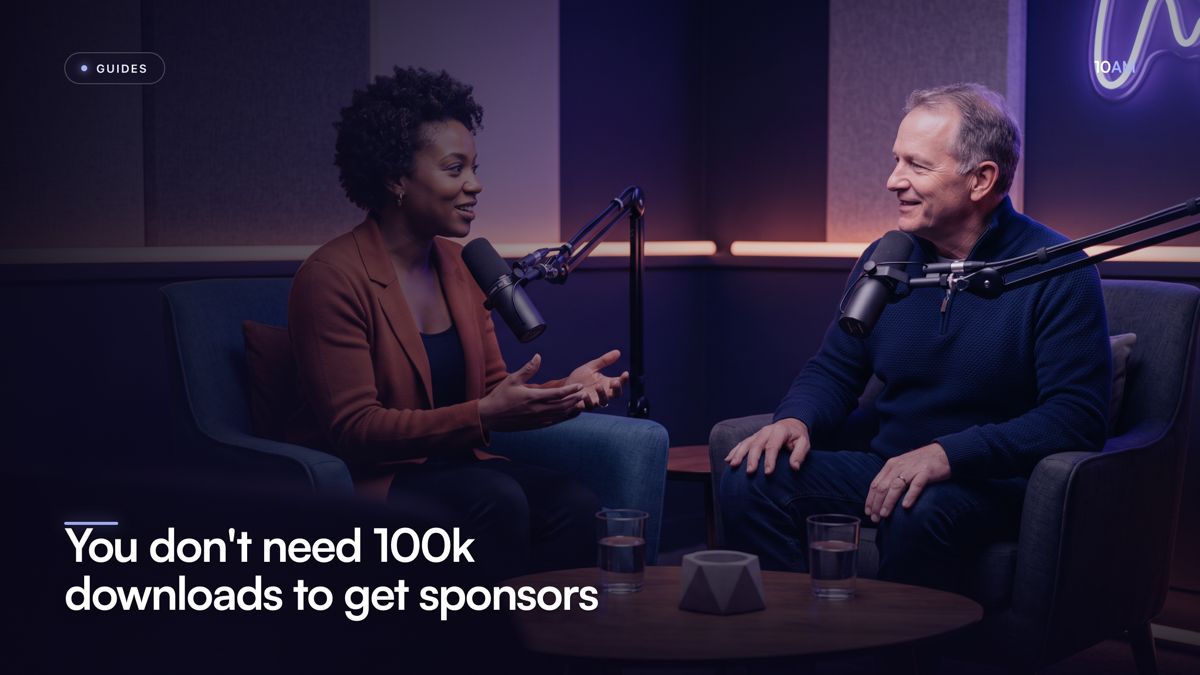
Somewhere along the way, a number got stuck in every new podcaster's head: 100,000 downloads. Below it, you are told, no sponsor will talk to you. It is one of the most discouraging myths in the medium, and it is wrong. Advertisers are not buying a download count. They are buying access to people who will act — and a small show can offer that better than a big one.
How small is "small," really?
First, a reality check on the numbers, because they are wildly misunderstood. Industry benchmarks put the top half of all podcasts at more than 30 downloads per episode. The top 25 percent clears about 100. The top 10 percent reaches roughly 400, and you crack the top 5 percent at around 1,100 downloads per episode. The top 1 percent starts near 5,400.
Read that again. A show doing 400 downloads an episode is in the top 10 percent of everything. The 100k figure is not a floor for getting sponsors — it is celebrity territory. Holding yourself to it means ignoring the size at which the vast majority of real sponsorship deals actually happen.
Advertisers buy fit, not reach
The reason the download myth persists is that it measures the wrong thing. A sponsor does not want 100,000 random ears; they want the few thousand — or few hundred — that match their customer. Podcast advertising has quietly shifted from a reach game to a fit game.
A 250-dollar spot on a show whose audience is exactly your customer can outperform a 7,500-dollar spot on a huge show whose audience mostly is not.
The proof is in the conversion data. Two-thirds of listeners trust host recommendations. Host-read ads deliver far higher brand recall than automated programmatic spots, and 54 percent of listeners say they are more likely to consider a brand after hearing it on a podcast. Those numbers are strongest exactly where the audience is tight and the host is trusted — which describes a well-run small show perfectly.
Why niche shows command higher rates
Counterintuitively, a smaller, sharper audience is often worth more per listener. Business, finance, and technology podcasts command 30 to 50 percent higher CPMs than general entertainment, because a listener who runs a company or manages money is worth far more to the right advertiser than a random entertainment listener.
So the goal is not to inflate your download number. It is to be able to finish this sentence with painful specificity: "My audience is ____, and they are actively trying to ____." The tighter that sentence, the less your raw size matters and the more your fit does. "Woodworking hobbyists shopping for their first serious table saw" is worth real money to a tool brand at 500 downloads; "general lifestyle audience" is not, even at 50,000.
What to bring instead of a big number
If you are not leading with reach, lead with these:
- A precise audience description. Who they are, what they do, what they are trying to buy or solve. Specific beats large.
- Engagement signals. Episode completion rates, listener replies, community activity, repeat listeners. These prove the audience actually shows up.
- Measurability. Offer a unique promo code or a trackable link so the advertiser can see exactly what your show drove. A small campaign they can measure beats a big one they cannot.
- Relevant proof. Screenshots of listeners asking where to buy things, past recommendations that landed, testimonials.
A quick worked pitch
Imagine a home-espresso show at 600 downloads per episode. Instead of apologizing for the number, the pitch reads: "600 downloads per episode of people who are actively upgrading their coffee setup — 68 percent finish the episode, and my last gear recommendation sold out the partner's stock in a week. Host-read mid-roll, unique code so you can track every sale." That is a package a specialty coffee brand says yes to at a premium CPM. The size is beside the point; the fit and the evidence are the pitch.
Let the right advertisers find you
The hardest part of small-show sponsorship used to be discovery: brands could not find you, and you did not have a sales team. That is the specific problem an ads marketplace solves. Instead of ranking shows by download count, it matches advertisers to shows by meaning — what your episodes are actually about, drawn from your transcripts and descriptions — so a brand looking for your exact topic finds you even if you are small.
Brand-safety checks run in the background, and you keep the final say on every deal — no ad runs on your show without your approval. Once a deal is signed, an ad studio can draft a host-style script in your voice, generate a natural read, and design a matching graphic, so you deliver a professional campaign without a production team. A trackable link proves the result.
The honest caveat: fit-based sponsorship still requires a clear, consistent show and a real relationship with your listeners. There is no shortcut around being genuinely useful to a specific audience. But you do not need to be famous. You need to be findable and specific — and 400 of the right listeners are worth more than 100,000 of the wrong ones.