What an embedding actually is
The idea behind meaning-based matching, without a single equation. Think of meaning as a location on a map, where things that are alike sit close together — and see how that map gets learned and where ours runs.
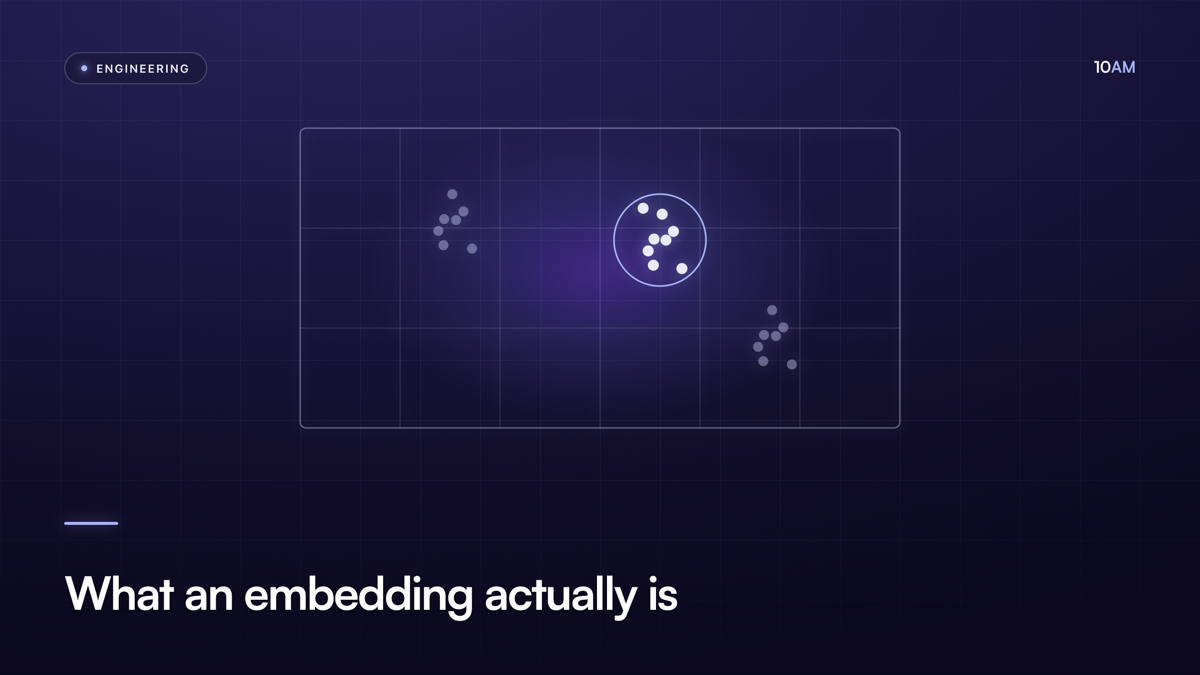
'Embedding' is one of those words that sounds like it's hiding something. It isn't. The concept underneath our ad matching is genuinely simple, and you can hold the whole thing in your head with one picture: a map. No math required. Here's the honest, plain-language version of what an embedding is and why it lets us match ads to shows by meaning instead of by keywords.
Meaning as a location on a map
Imagine a giant map where every idea has a spot. Not a map of places — a map of meanings. On this map, 'running shoes' and 'marathon training' sit close together, because they're related. 'Running shoes' and 'tax software' sit far apart, because they're not. An embedding is nothing more than the coordinates of something on that map. Turn a show into its coordinates, turn an ad campaign into its coordinates, and you've made two things you can compare by where they landed.
An embedding is just an address on a map of meaning — and things that mean similar things live in the same neighborhood.
The real map has far more than the two directions you can draw on paper — it has hundreds of them, which is how it captures many shades of meaning at once. But you don't need to picture the extra dimensions. The intuition holds perfectly at two: close means alike.
Near means alike
This is the entire trick, and it's why embeddings beat keyword matching. Keywords ask 'do these share the same words?' Meaning asks 'are these about the same thing?' Those aren't the same question.
- A show described as 'meal prep for busy weeknights' and a search for 'healthy dinner ideas' share almost no words — but they land in the same neighborhood on the map, so they match.
- A campaign for 'recovery gear for endurance athletes' lands near a show about ultramarathons, even if neither one uses the other's exact phrasing.
Because closeness on the map stands in for similarity of meaning, we can find good matches that a keyword system would walk right past. The connection is in the meaning, not the vocabulary.
How the map gets learned
Nobody sits down and assigns coordinates by hand — there are far too many ideas, and the relationships are too subtle. Instead, the map is learned from enormous amounts of text. The core insight it's built on is old and sturdy: things that show up in similar contexts tend to mean similar things. 'Coffee' and 'espresso' appear around the same words — mornings, cups, caffeine — so the learning process nudges them close together. 'Coffee' and 'crankshaft' rarely share a context, so they drift apart.
Repeat that nudging across a mountain of examples and, gradually, a coherent map takes shape where neighborhoods correspond to real themes. No one told it that lattes and cold brew are related; it noticed, from how people actually write about them. That's what people mean when they say a model 'learned' embeddings — it arranged the map so that context-mates ended up as neighbors.
What it does not understand
It's worth being honest about the limits, because the map is powerful but not magic. It has no idea what a podcast, a sneaker, or a marathon actually is. It has a statistical sense of what tends to appear alongside what — nothing more. That's usually enough to place related things near each other, but it also explains the occasional odd result: two things that happen to share surface context can land closer than they should, and something described in unusual language can land in the wrong neighborhood. The map is a very good approximation of meaning, not a mind. Treating it as an approximation is what keeps a matching system trustworthy.
Why this powers our marketplace
Everything about 10AM's ad matching rests on this one idea. We place every show on the map and every campaign on the map. To find fits, we look for campaigns and shows that landed in the same neighborhood. Because the map encodes meaning rather than exact words, an advertiser doesn't have to guess every phrase a creator might use, and a creator doesn't have to stuff their description with keywords to be found. Both just have to be what they are — the map handles the translation from words to meaning.
This is also why meaning-based matching feels different from a tag filter. Tags require someone to anticipate every relevant word in advance. The map generalizes: describe something a new way, and it still lands near its true neighbors.
Where ours runs
One detail we care about: we generate these embeddings on our own GPU, in-house. When we compute a show's or a campaign's location on the map, that work runs on infrastructure we operate rather than an outside service we'd call — and pay — on every request. Two things follow from that. The underlying content stays in our network instead of being shipped to a third party, and we can create embeddings as freely as good matching requires, without a per-call meter quietly discouraging us from doing the work well. The map is only useful if you're willing to place everything on it. Owning the machine is what lets us.