Should AI voice your ad? (when yes, when no)
AI voice reads are fast, consistent, and cheap to scale — and exactly wrong for some placements. An honest decision guide for when to use a generated read and when to insist on the host.
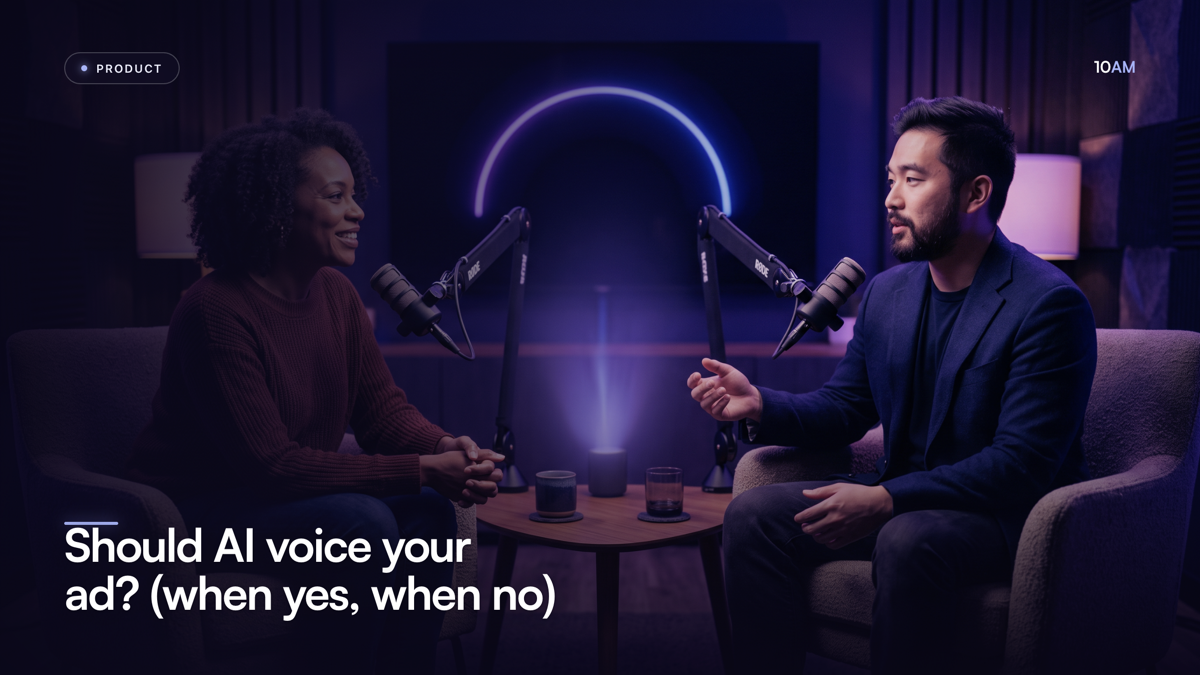
The honest tradeoff
An AI voice read is fast, endlessly consistent, and cheap to produce in many versions. That makes it genuinely useful — and genuinely wrong for some placements. The mistake is treating it as a drop-in replacement for a host. It isn't. A host-read borrows a person's credibility; a generated read borrows nobody's. Once you hold those two things apart, the decision gets easy.
Consider the economics. Host-read mid-rolls run roughly $25 to $50 CPM precisely because of that borrowed trust, and they convert three to five times better than programmatic spots on the same show. A generated read sits in the announcer category — closer to pre-recorded and dynamically inserted pricing of $3 to $15 CPM — because you're buying clean delivery and scale, not a personal endorsement.
When AI voice is the right call
- Information-led offers. A time-bound sale, a location, a set of dates, a clear feature — where the job is to say something correctly, not to vouch for it.
- Dynamically inserted spots at scale. When one campaign runs across many shows and slots, a consistent generated read keeps quality even where no host relationship exists.
- Fast iteration and testing. Generating ten script variants in an afternoon to find the one that converts, before you ever spend on a host's time.
- Pre-roll and post-roll. Positions where listeners already expect a produced ad break and aren't leaning in for a personal take.
Use AI voice where the value is information. Use the host where the value is trust.
When to insist on the host
Any spot whose power comes from "I actually use this" belongs to the host, full stop. Personality-driven shows, mid-roll endorsements, sensitive or high-consideration categories, and long-term brand partnerships all trade on a relationship an AI voice can't stand in for. Faking that — running a generated voice and letting listeners assume it's the host — is the one move that reliably backfires. A discerning audience notices, and the trust you were renting evaporates. If the read says "I," a real person should mean it.
A workflow that gets both
You don't have to choose once and forever. The strongest approach uses each tool for what it's good at. 10AM Media's Ad Studio drafts a host-style script from one brief and generates a natural voice read on the spot — so you can hear the spot, test the offer, and lock the timing in minutes. That generated version is perfect for pre-roll, DAI placements, and A/B testing the copy itself.
Then, for your best-performing shows, you hand that already-proven script to the host for a real endorsement — and because it stays fully editable, they start from a spine that's been tested, not a blank page. AI voice does the volume and the validation; the host does the vouching. That's the honest split, and it's the one that respects both your budget and your listeners.