Repurpose without a video editor
One recording can feed a whole week of content without touching a timeline. Here is the no-editor repurposing loop — from a single episode to captioned clips, cross-platform posts, ads, and merch — with honest notes on what this approach does and does not do well.
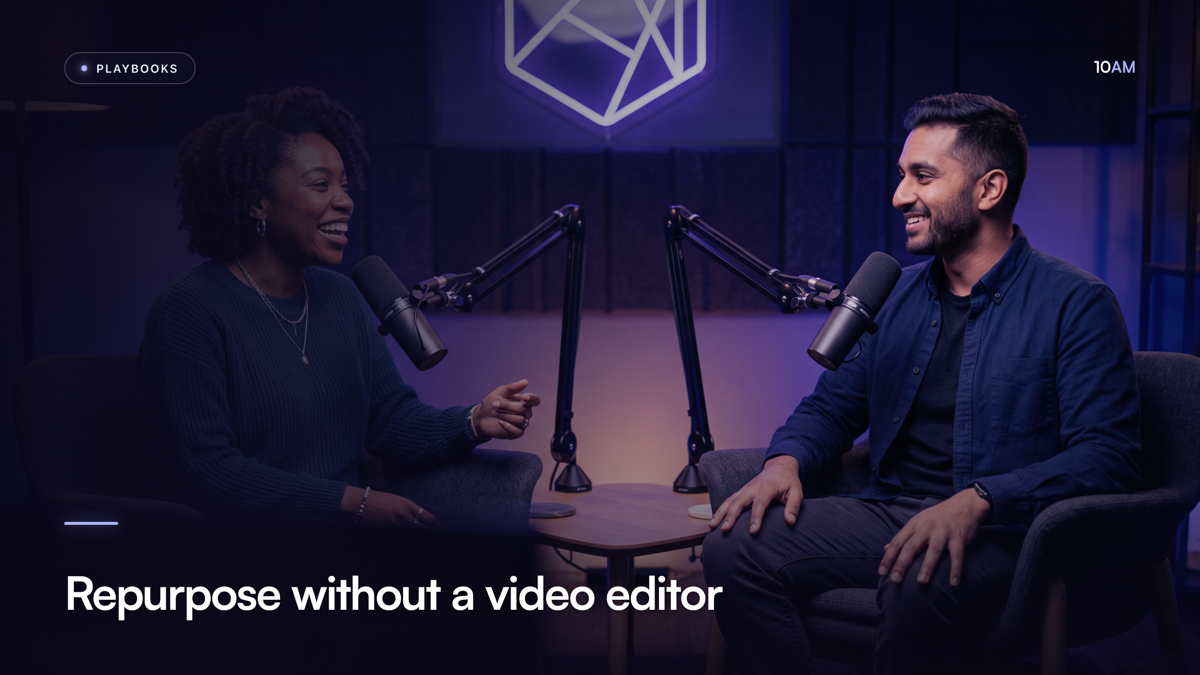
One recording, a week of content
The most valuable thing you already own is a finished episode, and most creators use maybe 5% of it. You record an hour, publish it once, and let the other fifty-nine minutes of good material sit in an archive nobody opens. Repurposing flips that ratio. Instead of one episode and silence until the next drop, a single recording becomes a steady stream of clips, posts, and assets across the week — and you can run the whole loop without ever opening a video editor. A one-hour episode typically holds 10 to 20 usable short clips. That is not one piece of content. That is a content calendar hiding inside a recording you have already made.
The no-editor loop
Traditional repurposing meant a timeline, a scrub bar, and hours of manual cutting — which is exactly why most creators never did it. The modern loop removes the editor from the critical path:
- Feed it the episode. Upload the recording or point it at your source; the system reads the full transcript.
- Review a ranked shortlist. Clips scores every moment for the traits that travel — hooks, contrarian takes, story payoffs, complete thoughts — and hands you the strongest candidates. You approve the ones that fit, which is a few minutes of judgment instead of an hour of scrubbing.
- Get finished clips. Approved moments come back auto-cut into captioned vertical clips, sized for short-form feeds, ready to post.
- Schedule the week. Queue them out so posting runs without you.
The key shift is what your job becomes. You are no longer an editor pushing pixels around a timeline. You are a curator making editorial calls on a shortlist — which is both faster and a better use of the thing only you have, which is taste.
It is worth being honest about where the old way actually cost you, because it was not only time. Manual clipping is so tedious that most creators, faced with it, simply did not clip — the episode went out once and that was the end of it. The tax was invisible: not hours spent, but a week of content never made, an audience never reached, a growth loop never started. When the cutting drops from an afternoon to a few minutes of review, the real change is not that clipping gets faster. It is that clipping actually happens at all, every week, instead of being the good intention you never got to.
The bottleneck was never a shortage of good moments in your episodes. It was the hours of manual cutting between the moment and the post. Remove that, and one recording feeds a week.
Audio-only still travels
You do not need a camera to repurpose. An audio-only show still produces shareable clips: captions carry the words on screen, and a branded background gives the eye something to watch, so a silent-autoplay viewer still gets a complete, readable moment. This matters because most short-form viewing happens on mute anyway — the caption track is doing the heavy lifting whether or not there was ever a camera in the room. The honest tradeoff: a purely audio clip loses the facial expression a video clip carries, and for the most emotional moments that expression is real content you are giving up. But weighed against the alternative — an audio-only show posting nothing to short-form at all — a captioned, branded clip is a large step up from silence.
Beyond clips: the rest of the recording's value
Clips are the obvious output, but the same recording feeds more than the feed. The point of repurposing is to extract every kind of value one recording can produce:
- Cross-platform posts. The same core moment can be reframed for different homes — a punchy hook for TikTok, a more context-forward cover line for LinkedIn. Same substance, tailored packaging.
- Ad reads that keep earning. A host-read placement recorded once lives on inside clips long after the episode drops, which is part of why host-reads are worth the effort. And Ad Studio can draft a script in your voice, generate the read, and design a matching graphic when you want an ad without writing one from scratch.
- Short links for everything. Links & Referral turns any clip, post, or ad into a trackable short link, so you can see which repurposed moments actually drive action — not just impressions.
- Merch off a breakout line. When a specific line takes off, the Store can put it on print-on-demand merch without inventory or upfront cost, turning a moment into a product.
The unifying idea: one afternoon of recording should not produce one asset. It should produce a set of them, each aimed at a different audience and outcome.
Think of the full episode, the clips, the posts, the ad reads, and the merch as one funnel rather than five chores. A stranger meets you through a clip in their feed. The clip's caption or link points them to the full episode, where they hear a host-read that a trackable code makes measurable. A line from that episode becomes the shirt a listener wears in public, which is itself a tiny billboard that sends the next stranger back to a clip. None of those pieces required a separate recording session — they are all the same hour of tape, wrung out completely instead of used once and shelved.
What repurposing does not do
Being honest about the limits is what keeps expectations sane. Two things this approach will not do for you:
- It will not save a flat episode. Ranking and auto-cutting are leverage on good raw material. If the recording had no strong moments, the clips will be weak too — no tool invents a hook that was never said. The work of making a genuinely good episode is still yours.
- It will not perfectly platform-tailor on autopilot. The same moment often performs differently on TikTok, Reels, Shorts, and LinkedIn, and getting the most out of each usually means a different hook or cover line per platform. The loop gets you a strong, postable starting point fast; the last-mile tailoring is a light human touch, not zero.
Keep those two honest limits in view and the value is enormous. You already do the hard part — showing up and recording something worth hearing. Repurposing without an editor just stops you from throwing away 95% of it. One recording, reviewed in minutes, becomes a week of clips, a few cross-platform posts, an ad that keeps working, trackable links, and maybe a piece of merch — all from material you were otherwise going to publish once and forget.
A closing note on where to spend the hours you get back, because the point of removing the editing tax is not to do nothing with the surplus. Put the reclaimed time into the two things no tool can do for you: making the episode itself better, and getting to know what your audience actually responds to. Every hour you are not scrubbing a timeline is an hour you could spend booking a sharper guest, tightening your questions, or studying which repurposed moments traveled last week. That is the real promise of repurposing without an editor — not that you make more content with less effort, but that you move your effort to the parts of the craft that compound, and let the machine handle the part that never did.