Brand safety without losing your voice
How to stay advertiser-friendly without sanding your show down to nothing — the real difference between brand safety and brand suitability, why keyword blocking backfires, and how meaning-based matching plus host approval protects both sides.
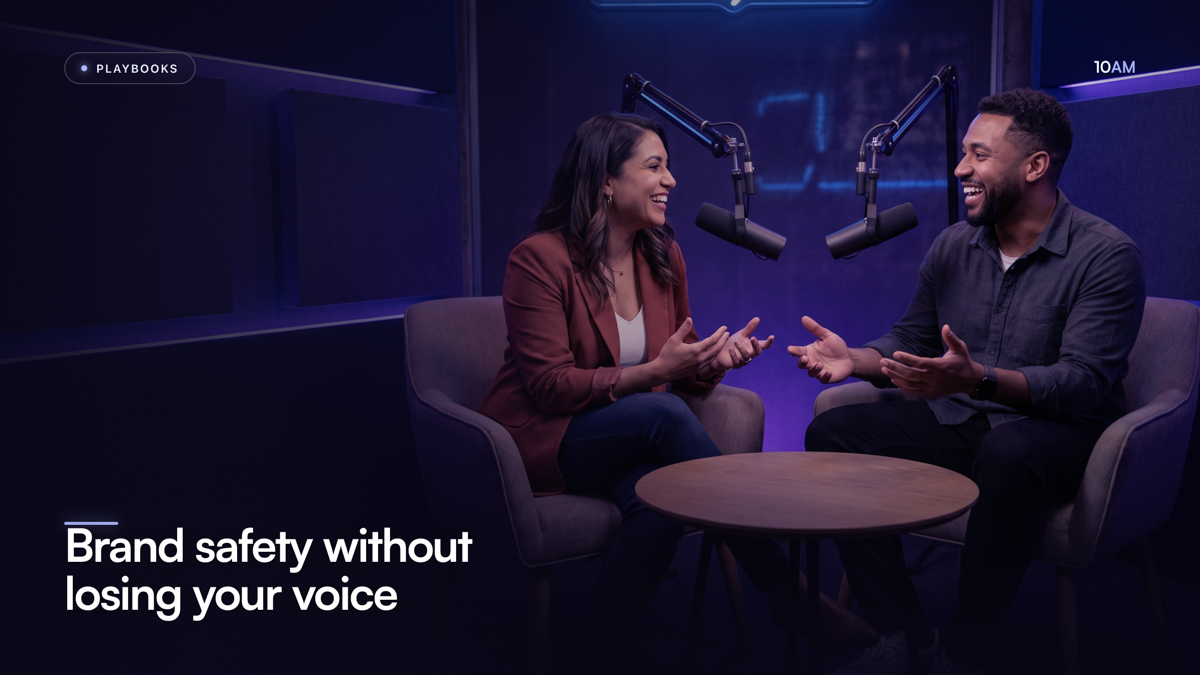
The fear on both sides of the deal
Two anxieties sit under every ad placement. The advertiser worries their brand will show up next to something that embarrasses them. The creator worries that to win those dollars, they will have to file the edges off their show until it says nothing. Both fears are reasonable, and both come from the same broken tool: crude, word-level filtering that treats language as a list of banned terms rather than something with meaning. Get the mechanics right and you can protect the advertiser and preserve your voice at the same time. Get them wrong and you slowly bore your audience to keep a sponsor who was never a good fit anyway.
Safety and suitability are not the same thing
The single most useful distinction here is one most people blur together. Brand safety is a universal floor — content no responsible advertiser should ever be monetized against. The Global Alliance for Responsible Media, or GARM, defined this with eleven categories covering things like explicit violence, hate, and serious crime. That floor is not controversial; almost nobody argues a soft-drink ad belongs next to it. Brand suitability is something else entirely: content that is completely safe but still wrong for a particular advertiser. An episode about grief is safe. It may still be unsuitable for a party-supply brand. Suitability is a preference, and it is specific to each buyer.
Safety is a line everyone agrees on. Suitability is a preference one advertiser holds. Treating a preference like a safety line is how a show ends up sanded down for no reason.
The reason this matters to you as a creator: most of the rejections that feel like censorship are actually suitability mismatches wearing a safety mask. The fix is not to change your show. It is to be matched with advertisers for whom your show is already suitable.
Why keyword blocking backfires
For years the default brand-safety tool was a keyword blocklist: hand an ad system a list of scary words, and it refuses to place ads on anything containing them. It sounds prudent. In practice it is both too strict and too dumb. A blocklist with the word shot on it will flag a basketball recap, a coffee tasting, a vaccine explainer, and a flu-season health segment — none of which are remotely unsafe. Those are false positives, and podcast brand-safety vendors have spent years trying to demystify exactly this problem for wary advertisers. The costs land on both sides. Advertisers lose access to large amounts of perfectly good inventory. Creators get quietly demonetized on episodes that broke no rule, with no explanation and no recourse.
There is a subtler damage too. Once creators learn which words trip the filters, some start avoiding those words — and then the topics around them. Industry observers have flagged this drift toward self-censorship as one of the real dangers of clumsy brand-safety enforcement. You do not notice it happening. You just gradually make a blander show.
Meaning beats word-matching
The way out is to judge what an episode is actually about, not which words appear in it. The Ads Marketplace reads the full transcript and description and matches on meaning, so an advertiser can steer by theme and context instead of a blunt word list. This is not just gentler — it performs better. Research from GumGum and Integral Ad Science found meaning-based, semantic matching produced roughly 2.5x higher brand recall and 40% stronger purchase intent than keyword-matched ads. Context understands that a true-crime host discussing a case is not endorsing crime, and that the word shot in an espresso review is not a safety event. The advertiser gets genuine protection where it counts; the creator keeps the episodes a keyword list would have wrongly buried.
It helps to separate two ideas that word-lists smash together: the topic of an episode and the treatment of it. A frank, careful discussion of mental health is a topic many advertisers would happily support; the same words in a reckless or exploitative treatment are not. A keyword filter cannot tell those two apart, because they share vocabulary. Meaning-based analysis can, because it reads the surrounding sentences the way a person would. That distinction is the entire reason serious health, news, and true-crime shows can carry advertising at all — they trade in heavy words responsibly, and only a system that grasps treatment, not just topic, can see that.
Barometer and Audiohook have gone a step further and built suitability definitions tailored specifically to audio, because a podcast's length, structure, and conversational tangents create context that web-page frameworks handle badly. The direction of travel across the whole industry is the same: away from words, toward meaning.
Host approval is the last, best guardrail
Automated matching gets you a strong shortlist. It should never get the final vote — you should. On 10AM Media the creator keeps final say on every placement, and that human check is not a formality. Two examples of things a machine will miss and you will not:
- A competitor conflict. You already have a relationship with one meal-kit brand; a rival matches on meaning. Only you know to decline it.
- A values call. The product is safe, suitable, and well-targeted — and you still would not use it. Your audience can hear the difference between an ad you believe and one you tolerated, and that belief is the entire reason host-reads convert.
Approval works in the advertiser's favor too. A host who declined their product still leaves them better off than a host who read it flatly and torched the campaign.
A workflow that protects your voice
Put it together and the discipline is light:
- Let meaning-based matching, not word blocklists, do the first pass — for advertisers, this means steering by theme and accepting that context resolves most apparent conflicts.
- Treat the GARM floor as the shared, non-negotiable safety line, and treat everything above it as a preference to be matched, not a reason to edit your show.
- Keep, and actually use, host approval. Decline mismatches without guilt; a wrong-fit sponsor costs you more in audience trust than it pays in cash.
- Make the show you would make with no sponsor in the room. Meaning-based matching is designed to find advertisers for that show — not to talk you into a quieter one.
The honest tradeoff: no system is perfect, and occasionally a good match will slip past or a marginal one will surface. That is exactly why the human veto exists. Used well, brand safety stops being a muzzle and becomes what it should be — a matchmaker that keeps bad fits away from your microphone so the good ones land harder.
It is worth naming who benefits when this works, because it is genuinely everyone at the table. The listener gets ads that fit the show they chose to spend time with, so the ads feel less like interruptions and more like recommendations. The advertiser gets placements in context they can stand behind, which is exactly the context that drives the recall and trust their money is chasing. And the creator gets to keep making the show that earned the audience in the first place, funded by sponsors who belong there. Crude filtering makes all three lose a little. Meaning plus judgment lets all three win — which is the only version of brand safety worth building a business on.