The anatomy of a great host-read
What actually separates a host-read that listeners act on from one they skip — the hook, the proof, the promise, and the single spoken call to action.
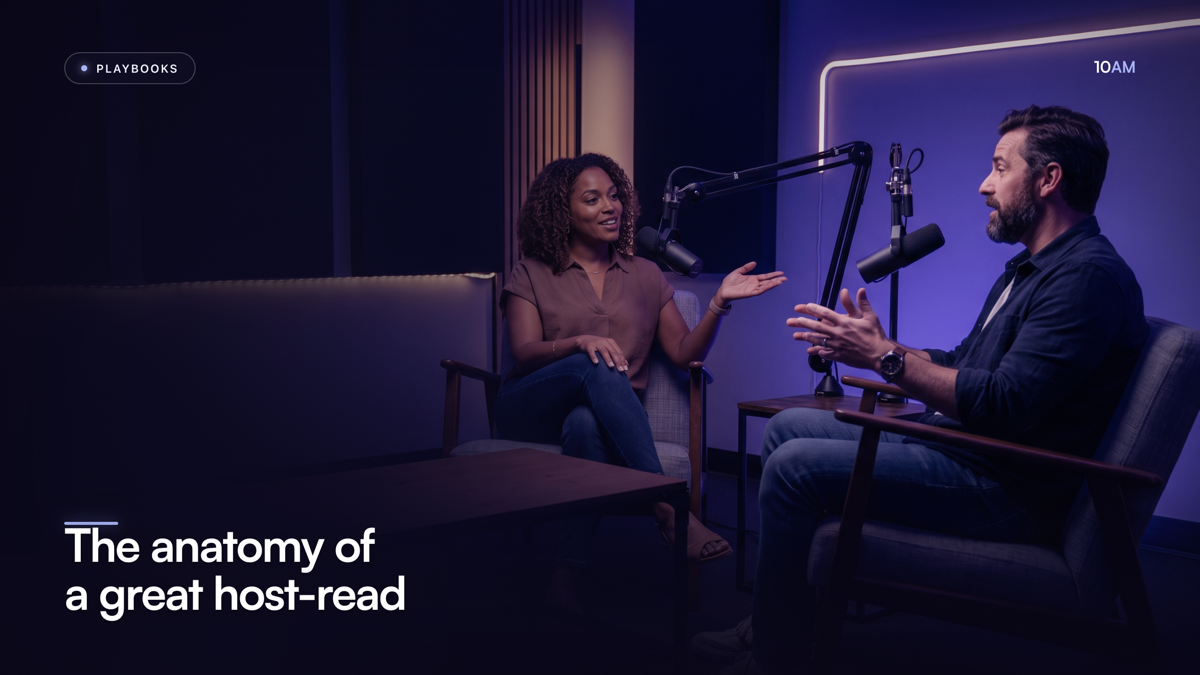
What a host-read actually is
A host-read ad is the moment a podcaster stops reading and starts talking to you. They say the sponsor's name in their own cadence, drop in a detail only they would know, and give you a reason to care before they give you a link. Listeners are not fooled into thinking it isn't an ad — they know exactly what it is — but they lean in because the recommendation is coming from a voice they already trust.
That trust is why host-reads command the premium they do. Mid-roll host-reads routinely run $25 to $50 CPM, while pre-recorded or programmatically inserted spots sit closer to $3 to $15. The gap isn't vanity pricing. In Podscribe's Q2 2025 benchmark, host-read ads outperformed producer-read spots by 31% on purchase rate, and host-reads commonly convert three to five times better than programmatic ads on the exact same show.
The five parts that make one work
Strip a great read down and the same skeleton is underneath almost every time:
- A hook that isn't the product. Open with the listener's problem or a moment from the host's week — not the brand name. Earn one more sentence of attention before you spend it.
- A proof point only this host could offer. "I keep one in my studio bag" beats "trusted by thousands." Specificity is the whole currency of a host-read.
- One promise, not a feature list. Pick the single outcome that matters most and let the other features live on the landing page.
- A call to action a person can remember while driving. One URL, one code, said slowly, ideally twice.
- An honest cue that it's an ad. A three-word disclosure keeps you clean with the FTC and, counterintuitively, makes the endorsement land harder.
A great host-read is not a script the host performs. It is a recommendation the host means.
Where reads go wrong
The most common failure is the wall of copy — a brief crammed with every benefit, forcing the host to sprint through it in a voice that stops sounding like them. The second is the buried ask: three great sentences of story, then a rushed, mumbled URL nobody can act on. The third is dishonesty by omission — a superlative the host clearly doesn't believe, which listeners hear instantly and never forget. If your read makes the host sound like a different person than the one who did the last 40 minutes, it will underperform no matter how good the offer is.
How to brief a read that lands
Give the host raw material, not a finished monologue: the one promise, the proof you'd love them to mention, the exact CTA to say verbatim, and — importantly — permission to say it their way. The best advertisers write the spine and let the host add the muscle.
This is exactly what 10AM Media's Ad Studio is built to draft. From a single brief, it writes a host-style script for the ear — short sentences, natural cadence, one promise, one clear CTA — that a host can read as-is or make their own in a pass or two. It handles the structure so the human handles the trust. And because the read stays fully editable, the host keeps final say over every word that goes out under their voice. That combination — a strong spine, drafted fast, plus a host who means it — is the anatomy every high-performing spot shares.